Optimizing Outcomes with Minimal Overhead
Not every client has the budget or bandwidth to incorporate training modules that require high-end software. The good news is that often, these clients already have the software to enact effective training solutions, simply by partnering with someone who can unlock hidden capacities of these tools.
Focus: Cognitive Benefits of Multimedia Learning
Roles: Co-Designer, Co-Producer (along with Paulette Addison)
Tools: PowerPoint (interactive), Adobe Express
Need: Train educational professionals to replace passive, lecture-centered teaching methods with interactive, student-centered content delivery.
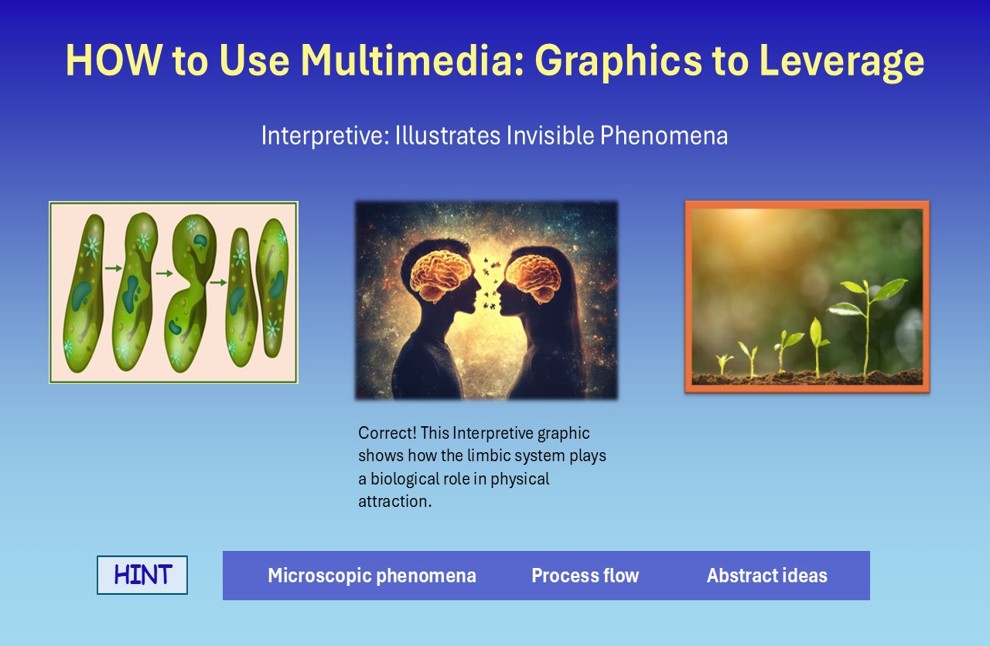
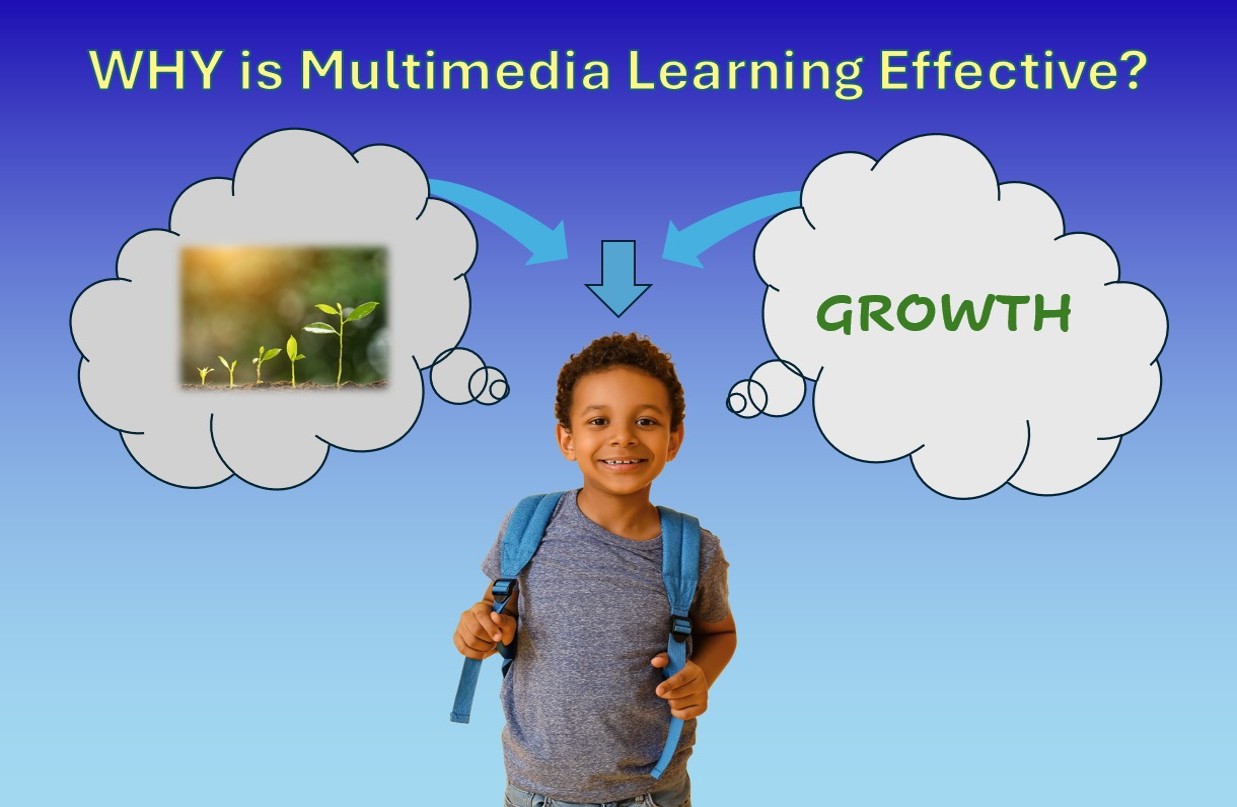
Solution: This mini-module leverages both explicit research and implicit methodology to demonstrate Mayer's Multimedia Principles in higher education environments. With an inexpensive and universal tool (PowerPoint), Addison and I designed an interactive mini-unit demonstrating the efficacy of Mayer's Principles of Multimedia and Contiguity for deeper student cognition.
Organizational Strategy: This mini-unit loosely reflects Dick and Carey's framework, particularly in its explicit announcement of objectives and emphasis on learner practice and feedback. Through modeling, professors-as-learners see how PowerPoint can be programmed to provide on-demand feedback, thus undergirding the practice loop advocated by Dick and Carey as well as other educational researchers. The mini-unit's conclusion involves an opportunity for more differentiated feedback based on a short essay assessment.
Delivery Strategy: Dynamism and subtle humor that reinforce, rather than distract from, the learning objectives are distinctives that no AI and not many instructional designers can achieve, regardless of the medium. However, this project incorporates both in ways that reflect Keller's ARCS theory of motivation. Almost immediately, target learners (higher ed professionals) encounter relevant rationale, and learning is propelled by on-demand hints to aid confidence for learners with less topic knowledge.
Development Strategies: Undergirding the explicit teaching of Mayer's Principles, this mini-unit exemplifies best practices in multimedia instruction, incorporating organizational, relational, and tranformational graphics for research-driven, targeted learning. Graphics arrangement, fonts, and color schemes reflect Golombisky and Hagen's practical guidelines for inviting, harmonious design. By building a self-paced, adjustable-scaffolding module through PowerPoint and deploying it through Instructure's Canvas LMS, my colleague and I demonstrated the unrealized potential of these tools for facilitating professional and effective learning experiences.
This project also spotlights my experience in professional collaboration, part of AECT Standard 4. Following a framework suggested by our professor, my colleague and I set internal deadlines, methods of communication, and individual content development for this assignment. We did encounter challenges to the internal schedule, but solid communication and work ethic enabled us to complete the overall project by the final deadline, with highly rated results. The professor and program head requested to use our work as an exemplar of creative partnership.